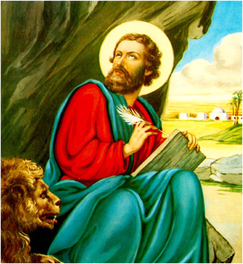
Who is St. Mark?
Apostle, martyr, and founder of the Coptic Orthodox Church of Alexandria.
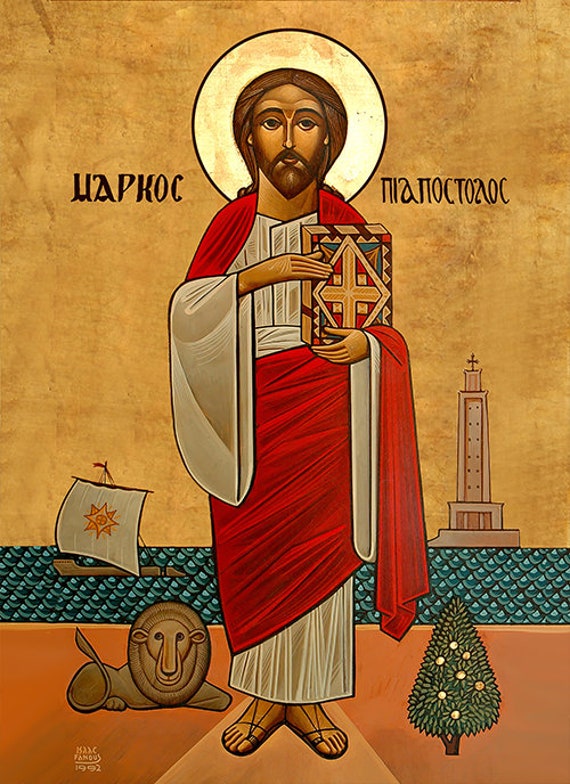
St. Mark the Apostle, known in our tradition as the ⲡⲓⲑⲉⲱⲣⲓⲙⲟⲥ ⲛ̀ⲉⲩⲁⲅⲅⲉⲗⲓⲥⲧⲏⲥ (The Divine Seholder of God and Evangelist), holds a position of singular honor as the founder of the See of Alexandria and the first Patriarch of the Coptic Orthodox Church. Born in Cyrene of North Africa to Jewish parents, Aristopolus and Mary, he was later raised in Palestine. Mark was a man of two worlds, possessing a deep knowledge of the Law and the Prophets, yet witness to the arrival of the Messiah. His family was closely knit with the early apostolic circle; his mother, Mary, was one of the faithful women who followed Christ, and his cousin was St. Barnabas. It was in Mark's family home, particularly the Upper Room (Zion Room), where the most pivotal events of Christianity unfolded: the Last Supper, the washing of the disciples' feet, and the descent of the Holy Spirit on the Day of Pentecost. Thus, his home is rightfully recognized as the first Christian church in the world.
The early life of St. Mark was marked by divine providence and miraculous protection. A tradition held dearly in the Coptic Church relates an encounter St. Mark and his father had with two lions in the wilderness near the Jordan River. When the beasts approached to devour them, Mark prayed fervently in the name of ⲓⲏⲥⲟⲩⲥ ⲡⲭⲣⲓⲥⲧⲟⲥ (Jesus Christ), and the lions immediately burst asunder and died. This event not only led to the conversion and baptism of his father but also serves as the theological basis for why St. Mark is symbolized by the Lion in Christian iconography. The lion represents his courage, the "voice crying in the wilderness," and the kingly power of Christ that he proclaimed through his Gospel. As the "Beholder of God," he was among the seventy disciples whom Christ sent out to preach, witnessing the miracles and teachings of the Savior firsthand.
St. Mark's arrival in Alexandria in approximately 61 AD marks the most significant turning point in the history of Egypt. Alexandria was then a world capital of philosophy, science, and pagan idolatry, dominated by the great Library and the temple of Serapis. As he entered the city, the strap of his sandal tore-a seemingly mundane event that became the catalyst for the conversion of an entire nation. He visited a cobbler named Anianus to have it repaired. While working, the awl pierced Anianus's hand, and he cried out, "ⲉⲓⲥ ⲑⲉⲟⲥ!" (Oh, One God!). Seizing this moment, Mark spat on the ground, made clay, applied it to the wound, and healed him instantly. He then began to preach to Anianus about the true God and His Son, leading to the baptism of Anianus and his entire household. Anianus would later become the second Patriarch of Alexandria, succeeding Mark after his martyrdom.
As the author of the first written Gospel, St. Mark provided the Church with a succinct and powerful record of Christ's life, focusing on His actions and His victory over the powers of evil. Written originally for the Romans, his Gospel is characterized by urgency-often using the word "immediately"-and a vivid portrayal of Christ as the Servant and the Son of God. In Alexandria, he did not only preach; he established the foundations of the faith by founding the Catechetical School of Alexandria. This school would go on to be the intellectual powerhouse of early Christianity, producing giants like Pantaenus, Clement, and Origen, and ensuring that the Coptic Church remained a bastion of theological depth and scriptural exegesis against the "philosophy and empty deceit" of the pagan world.
The missionary zeal of St. Mark extended far beyond the borders of Egypt. He accompanied St. Paul and St. Barnabas on their missionary journeys, serving as a minister to them. Although there was a brief period of contention between Paul and Barnabas regarding Mark's participation, St. Paul later wrote in his second epistle to Timothy, "Get Mark and bring him with you, for he is useful to me for ministry." This restoration highlights Mark's humility and perseverance. He also visited Rome, where he served alongside St. Peter, whom he regarded as a spiritual father. Indeed, the ancient tradition refers to the Gospel of Mark as the "Memoirs of Peter," reflecting the close apostolic bond between the two, yet Mark remained the distinct Evangelist of the African continent and the East.
St. Mark's success in Alexandria eventually drew the murderous ire of the pagan worshippers of Serapis. In 68 AD, the feast of the Resurrection coincided with the pagan festival of Serapis. The enraged mob seized St. Mark while he was celebrating the Divine Liturgy at the church in Baucalis. They tied a rope around his neck and dragged him through the streets of the city and over its jagged rocks for two consecutive days. During the night, while he lay in a dark prison, bruised and bleeding, our Lord appeared to him in a great light, strengthening him and promising him the crown of life. The following day, the mob resumed their torture until his soul departed his body. He sealed his testimony with his own blood and earning the title of "the Apostle, the Evangelist, and the Martyr."
The legacy of St. Mark is inextricably linked to the preservation of the Coptic Liturgy and the stability of the See of Alexandria. The Liturgy of St. Cyril, which we pray to this day, is in its essence the "Liturgy of St. Mark," the ancient rite he delivered to the first Christians of Egypt. His body remained in Alexandria for centuries and was a site of great pilgrimage until it was stolen by Venetian merchants in 828 AD and taken to Italy. However, in a moment of great historical justice and joy, a portion of his relics was returned to the Coptic Church in 1968 under the papacy of Pope Cyril VI. These relics now rest beneath the altar of the St. Mark Coptic Orthodox Cathedral in Cairo, serving as a physical link to our founder and a reminder that the Church of Alexandria stands upon an apostolic and martyric foundation that cannot be shaken.
Finally, St. Mark is celebrated in our hymns and doxologies as the "three-crowned" saint. As the Doxology states, ⲁⲕⲉⲣⲫⲟⲣⲓⲛ ̀ⲙⲡⲓϣⲟⲙⲧ ⲛ̀ⲭ̀ⲗⲟⲙ (You were clothed in three crowns): the crown of Apostleship, the crown of Martyrdom, and the crown of Evangelism. He is the father of all Copts, the one who turned a land of idols into a land of crosses. Without his courage to enter the "Den of Lions" that was pagan Alexandria, the spiritual riches of the Egyptian desert and the theological triumphs of St. Athanasius and St. Cyril would never have come to pass. We remain forever indebted to St. Mark, crying out to him, "May your prayer be with us, O Beholder of God, Mark the Apostle, that He may forgive us our sins." His voice continues to roar like a lion throughout the world, calling all people to the true faith of the one, holy, catholic, and apostolic Church.